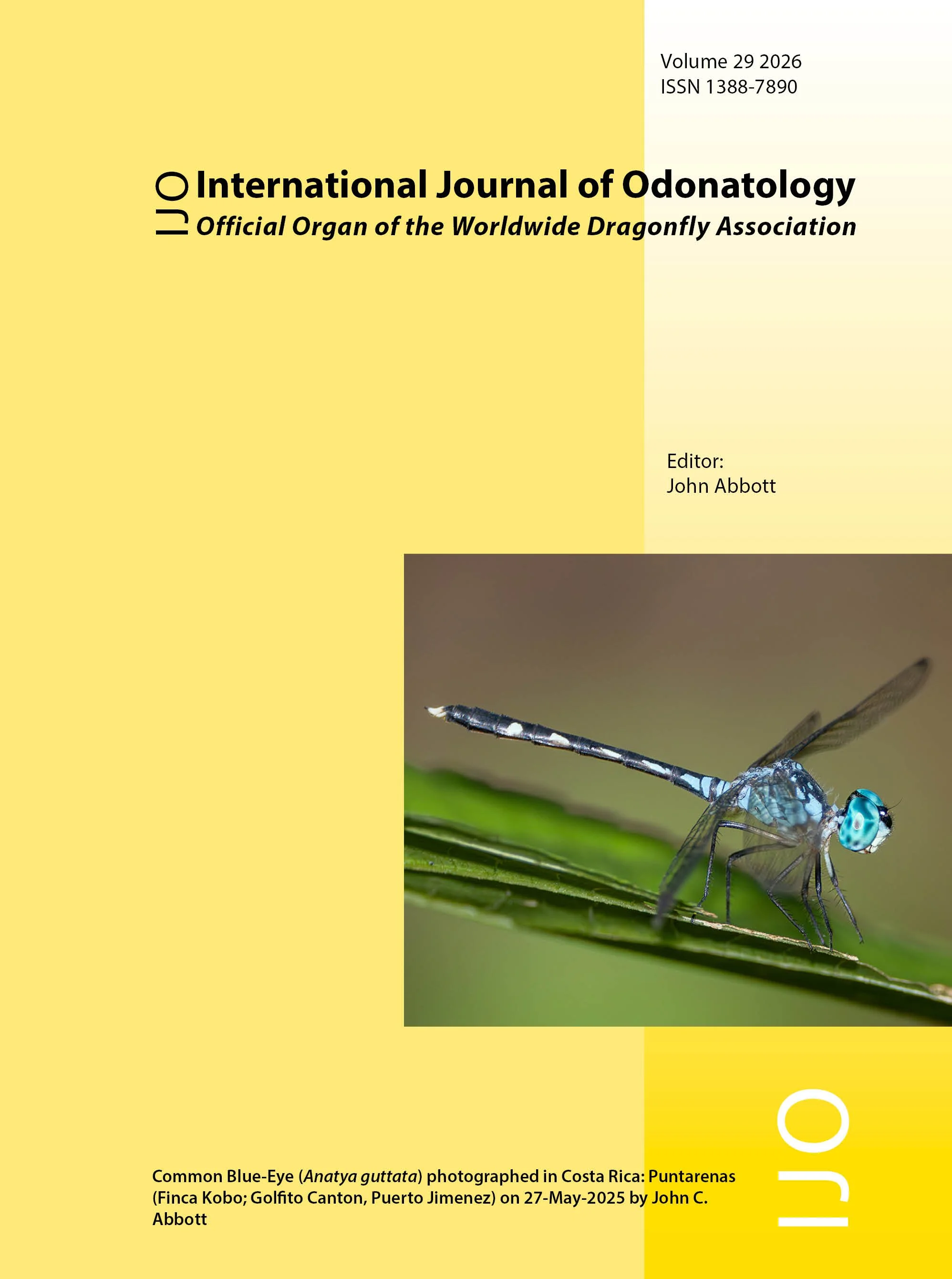
Volume 29, 2026
Intraspecific rather than interspecific drivers of female-limited polymorphism in Calopteryx splendens (Odonata: Calopterygidae)
Female-limited colour polymorphism is widespread in Odonata, particularly in the Coenagrionidae, where it is determined by simple Mendelian inheritance. In contrast, female-limited colour polymorphism in Calopterygidae is restricted to some populations of the Palaearctic Calopteryx splendens complex, whose males have blue-spotted wings and females occur either as gynochromes with transparent wings or as androchromes with dark brown-spotted wings.
Hetaerina giselae sp. n. (Odonata: Calopterygidae) from Southeastern Brazil, with larval and adult diagnosis
Hetaerina giselae sp. n. is described and illustrated based on specimens collected at Pico do Itambé State Park, Minas Gerais, Brazil. Integration of morphological and molecular data (COI) supports the recognition of the new species.
Description of Lyriothemis keralensis sp. n. (Odonata: Libellulidae) from the southwestern coast of India
A new species of dragonfly, Lyriothemis keralensis sp. n. is described from the coastal plains adjoining the Western Ghats of Kerala, southern India, based on a male holotype (IBC-CD161) and a female paratype (IBC-CD310) (type specimens are deposited in the Biodiversity Lab Research Collections, currently held at the National Centre for Biological Sciences, Bengaluru).
Larval competition does not affect the frequency of androchrome females but changes sex-ratio in Ischnura graellsii (Odonata: Coenagrionidae)
The maintenance of colour polymorphisms in natural populations is often explained by contrasting selective forces acting on the life cycle stage that shows the polymorphism. Nevertheless, in animals with complex life cycles, selection during the larval stage, which usually is the longest development phase and might accumulate 99% of overall mortality, could be a determinant force if the genes that affect adult colour have pleiotropic effects on larval phenotype.
Molecular insights into the diversity of odonates in the Andaman and Nicobar Islands using 16S rRNA gene
The Andaman and Nicobar Islands represent a unique biogeographic region characterized by high biodiversity and endemism, yet molecular studies on insect taxa, particularly Odonata remain limited. This study investigates the phylogenetic relationships and species boundaries among odonate taxa from the islands using mitochondrial 16S rRNA gene sequences.
Odonata (Insecta) survey in Atlantic Forest Conservation Units in southeastern Brazil: rare species and new records
The Atlantic Forest, one of the world’s most threatened biodiversity hotspots, is home to a rich diversity of Odonata, a group with great potential for further research in this phytophysiognomy. Considering this, the aim of this study was to update the data on Odonata species found in four conservation units of the Atlantic Forest biome in the states of São Paulo, Minas Gerais and Espírito Santo, highlighting their diversity and distribution.
Description of the female of Teinobasis fatakula Marinov & Donnelly, 2013 (Zygoptera: Coenagrionidae) from the Kingdom of Tonga
An expedition in 2024 to ‘Eau Island in the Kingdom of Tonga led to the collection of several female Teinobasis fatakula Marinov & Donnelly, 2013. Teinobasis fatakula is endemic to ‘Eua and can only be found inhabiting a single river in the ‘Eua National Park. Here we describe the female of this unique damselfly and expand its range.
Notes on Amazoneura, with description of A. submontana, a new species of damselfly from Peru (Odonata: Protoneuridae)
Amazoneura submontana sp. n. (holotype ♂: Peru, San Martín Región) is described and illustrated. Males of A. submontana can be distinguished from the other three known members of the genus by the shape of the cerci and absence of a dark ventral cross band behind the metacoxa in mature specimens.
A new species, Pseudagrion yalomi, of the Pseudagrion red-group from New Britain, Papua New Guinea (Zygoptera: Coenagrionidae)
A new species of Pseudagrion red-group, Pseudagrion yalomi sp. n., is described from northeastern New Britain, Papua New Guinea.
Identification and distribution of the Philippine endemic Trithemis adelpha (Odonata: Libellulidae)
A review based on material available at Naturalis Biodiversity Center (RMNH) and images available on iNaturalist and Observation.org shows that Trithemis adelpha, often regarded a synonym of T. aurora, is a valid species and can be identified with relative ease.
The classification and diversity of extant dragonflies and damselflies (Odonata)
We present an updated classification for extant dragonflies and damselflies (Odonata) and summarize new insights gained over the past two decades. Our focus is on taxa of family-level and higher and we indicate subfamilies only when their monophyly is currently undisputed and well-supported by phylogenetic analyses.
Systematics, divergence time, biogeography, and trait evolution of the dragonfly genus Erythemis Hagen, 1861 (Anisoptera: Odonata)
The dragonfly genus Erythemis Hagen, 1861, in the hyper-diverse family Libellulidae Leach, 1815, contains ten species that are found across the Americas. Species relationships have never been resolved for this group, and doing so will provide a framework to understand the considerable interspecific variation present in traits, including genital morphology, abdomen shape, and flight activity.
Unusual behavior of males of Aeshna cyanea (Odonata: Aeshnidae) to achieve a pairing
Males of Aeshna cyanea employed specific behaviors to induce non-cooperative females into the mating position. Biting the female was used as a coercive behavior, thus showing a new function of biting in odonates.
Dragonflies of Pico do Itambé State Park: diversity and composition of an Odonata community in the Espinhaço Mountains
The reduction and modification of the Atlantic Forest and Campo Rupestre make it urgent to conduct inventory studies that provide data on the distribution of biota. However, many areas lack information, including those within Conservation Units (CUs) considered priorities for conservation, such as the Pico do Itambé State Park (PEPI) in the Espinhaço Range, Minas Gerais, which lacks information regarding its odonatofauna.
A new species of Lestes Leach, 1815 (Odonata: Zygoptera: Lestidae) from the Western Ghats of Keralam, southern India
A new species of damselfly, Lestes paloti sp. n. (Odonata: Lestidae) is described from Keralam on the western slopes of the Western Ghats, southern India.
Demography of the dragonfly Rhionaeschna caligo (Aeshnidae), a species endemic to the northwestern Andes in Colombia
Páramos are unique ecosystems located in the highest parts of tropical mountains. Despite harboring great biological diversity, they are also considered one of the most threatened ecosystems in the world. Rhionaeschna caligo is an endemic and threatened species that inhabits these ecosystems in the north of Colombia’s Central and Occidental Cordilleras.
Leucobasis puinave sp. nov. (Odonata: Coenagrionidae), a new damselfly species from Colombia with updated generic characterization
A new damselfly species, Leucobasispuinave sp. nov., is described from 9♂♂, 2♀♀ collected in Guainía department in eastern Colombia. This is the second known species of the genus Leucobasis, and it can be separated from L. candicans by its size and the main coloration of S7–10.
Biometric data of the female of Cordulegaster boltonii algirica Morton, 1916 (Anisoptera: Cordulegastridae) from Morocco with notes on subspecies occurrence
Nineteen females of Cordulegaster boltonii algirica were measured and documented in the field across seven localities in the Rif Mountains and Tazzeka Mountains in northern Morocco in June 2008, June 2015, and June 2024. Their morphological characteristics are described.
Patrolling and dispersal flight patterns of males of Cordulegaster boltonii (Odonata: Cordulegastridae)
The spatial ecology of stream-dwelling Odonata is traditionally assumed to involve strict territoriality and negative density-dependent dispersal. This study challenges these paradigms by investigating the spatial dynamics of the Golden-ringed Dragonfly (Cordulegaster boltonii).