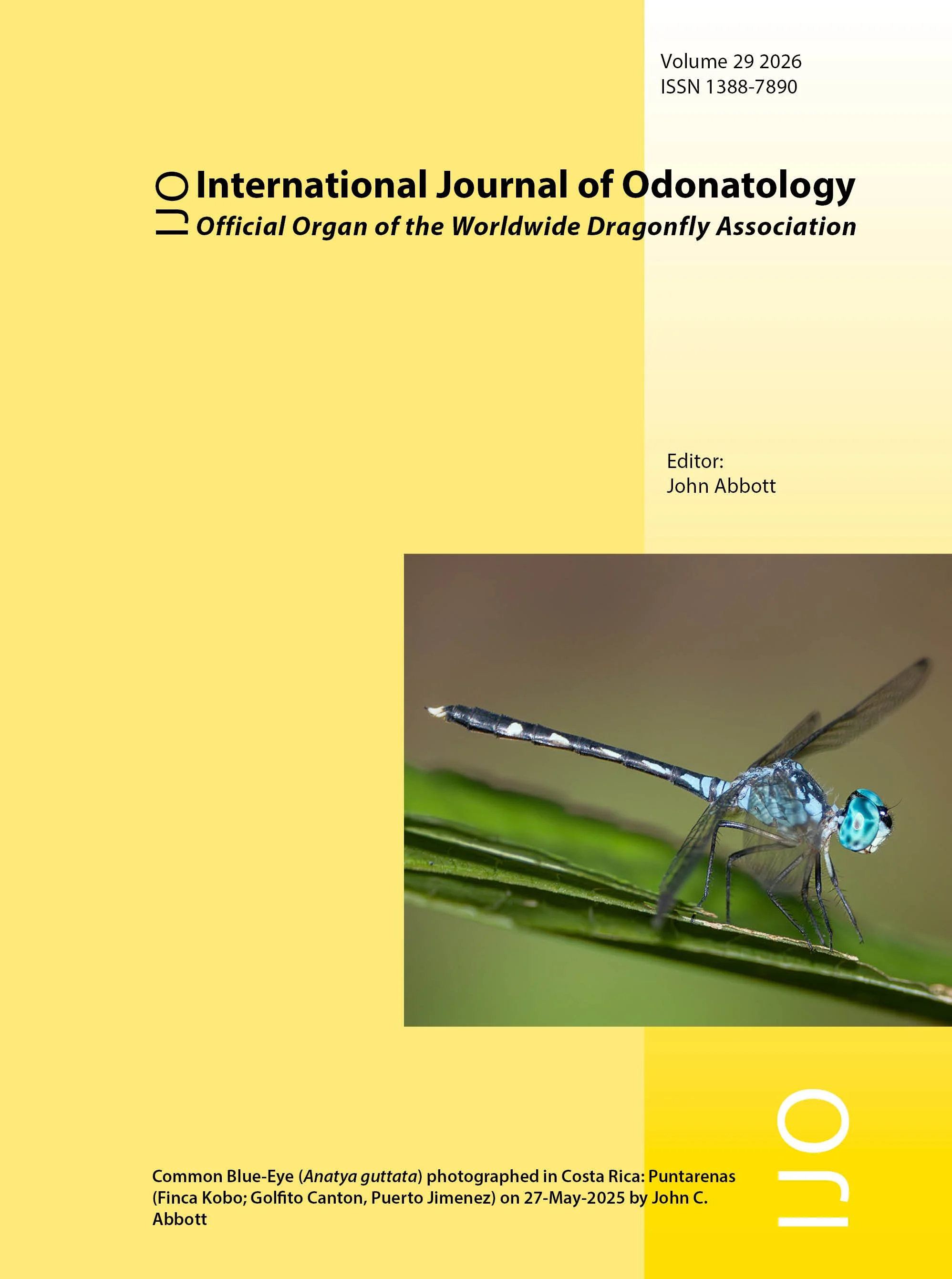
The classification and diversity of extant dragonflies and damselflies
(Odonata)
The classification and diversity of extant dragonflies and damselflies (Odonata) 00
Payton Cartera  ,
Aaron Goodmanb ,
John Abbottc ,
Cornelio Bota Sierrad ,
Seth M. Bybeea,
Rory A. Dowe,o ,
Judicael Fomekong Lontchia,
Paul B. Frandsenf ,
Laura Gonzalez Mozoa ,
Rob Guralnickg,
Matti Hämäläinene ,
Shantanu Joshih ,
Manpreet K Kohlii,
Pungki Lupiyaningdyaha,n,
Katherine Montanab ,
Lacie Newtonb ,
Violet Onsongob ,
Albert G. Orrj ,
Ângelo Parise Pintok ,
Melissa Sanchez-Herrerab,c ,
Laura N. Sutherlanda ,
Gunther Theischingerl ,
Jessica L. Wareb ,
Haomiao Zhangm ,
Vincent J. Kalkmand ✉️
,
Aaron Goodmanb ,
John Abbottc ,
Cornelio Bota Sierrad ,
Seth M. Bybeea,
Rory A. Dowe,o ,
Judicael Fomekong Lontchia,
Paul B. Frandsenf ,
Laura Gonzalez Mozoa ,
Rob Guralnickg,
Matti Hämäläinene ,
Shantanu Joshih ,
Manpreet K Kohlii,
Pungki Lupiyaningdyaha,n,
Katherine Montanab ,
Lacie Newtonb ,
Violet Onsongob ,
Albert G. Orrj ,
Ângelo Parise Pintok ,
Melissa Sanchez-Herrerab,c ,
Laura N. Sutherlanda ,
Gunther Theischingerl ,
Jessica L. Wareb ,
Haomiao Zhangm ,
Vincent J. Kalkmand ✉️
- Department of Biology and Monte L. Bean Life Science Museum, Brigham Young University, Provo, Utah, USA
- Division of Invertebrate Zoology, American Museum of Natural History, New York, New York, USA
- The University of Alabama Museums Research and Collections, The University of Alabama, Tuscaloosa, Alabama, USA
- Grupo de entomología Universidad de Antioquia (GEUA), Universidad de Antioquia, Medellín, Colombia. Calle 67 #53-108, PC050010
- Naturalis Biodiversity Center, Leiden, The Netherlands
- Department of Plant and Wildlife Sciences and Bean Life Sciences Museum, Brigham Young University, Provo, UT
- Florida Museum of Natural History, University of Florida, Gainesville, Florida, USA
- Department of Biological Sciences, University of Arkansas, Fayetteville, AR 72701, USA
- Baruch College and The Graduate Center, City University of New York, New York, NY, USA
- Environmental Futures Research Institute, Griffith University, Nathan, Australia
- Departamento de Zoologia, Laboratory of Systematics on Aquatic Insects (LABSIA), Universidade Federal do Paraná, Curitiba, Paraná, Brazil
- Australian Museum, Entomology, 6 College Street, Sydney, NSW 2010, Australia
- Kunming Natural History Museum of Zoology, Kunming Institute of Zoology, Chinese Academy of Sciences, Kunming, Yunnan 650223, China
- Research Center for Biosystematics and Evolution, Research Organization of Life Sciences and Environment, National Research and Innovation Agency (BRIN), Cibinong, West Java 16911, Indonesia
- Institute of Biodiversity and Environmental Conservation, Universiti Malaysia Sarawak, 94300 Kota Samarahan, Sarawak, Malaysia
International Journal of Odonatology, Volume 29, Pages 95-124, 2026
https://doi.org/10.48156/1388.2026.1917385
Published: 1 June 2026 (Received: 15 April 2026, Accepted: 17 April 2026)
Abstract
We present an updated classification for extant dragonflies and damselflies (Odonata) and summarize new insights gained over the past two decades. Our focus is on taxa of family-level and higher and we indicate subfamilies only when their monophyly is currently undisputed and well-supported by phylogenetic analyses. The superfamily Calopterygoidea was known to be polyphyletic and based on recent phylogenomic data is divided into nine superfamilies, of which eight are recognized for the first time (Amphipterygoidea stat. nov., Euphaeoidea stat. nov., Megapodagrionoidea stat. nov., Mesopodagrionoidea stat. nov., Philogangoidea stat. nov., Polythoroidea stat. nov., Priscagrionoidea stat. nov., Tatocnemidoidea stat. nov.). At present, midway through 2025, odonates are divided into three suborders, 17 superfamilies, 55 families and 687 genera containing 6447 species (May 1, 2025). We give an overview of the distribution of the families across major biogeographical realms. Except for Amanipodagrionidae, nymphs of at least some of the species of all families are known. Our understanding of the classification of dragonflies and damselflies has greatly improved in the past two decades largely due to phylogenetic inferences based on molecular studies. We expect that in the next few years the last remaining issues regarding the higher-level phylogeny and classification, including the position of the South American genus Sciotropis and the division into subfamilies of families such as Coenagrionidae, Aeshnidae, Gomphidae and Libellulidae, will be better refined by the acquisition of additional morphological and genomic data.
Keywords: Biogeography, nomenclature, superfamilies
Amphipterygoidea
http://www.zoobank.org/urn:lsid:zoobank.org:act:0657A466-39E0-4C34-9A57-98B6421CA37C
Euphaeoidea
http://www.zoobank.org/urn:lsid:zoobank.org:act:DB2FC7B3-24AE-4941-99B1-B24ECB75EC65
Megapodagrionoidea
http://www.zoobank.org/urn:lsid:zoobank.org:act:8B731434-A8F2-49E8-9E78-840A4BF4A0B4
Mesopodagrionoidea
http://www.zoobank.org/urn:lsid:zoobank.org:act:F44AEE7F-0DC4-4179-A48F-667B2BB8FF54
Philogangoidea
http://www.zoobank.org/urn:lsid:zoobank.org:act:DF9D339A-3714-43BE-B273-027514FAEE1B
Polythoroidea
http://www.zoobank.org/urn:lsid:zoobank.org:act:868E6753-774C-44B9-A56E-17E3FF4E15BC
Priscagrionoidea
http://www.zoobank.org/urn:lsid:zoobank.org:act:4C5F0CB8-4A34-42C6-A1A2-1A74CB3742A6
Tatocnemidoidea
http://www.zoobank.org/urn:lsid:zoobank.org:act:389591DF-16DB-43EF-8D8B-369AC1777B4C
Issue section: Original Article