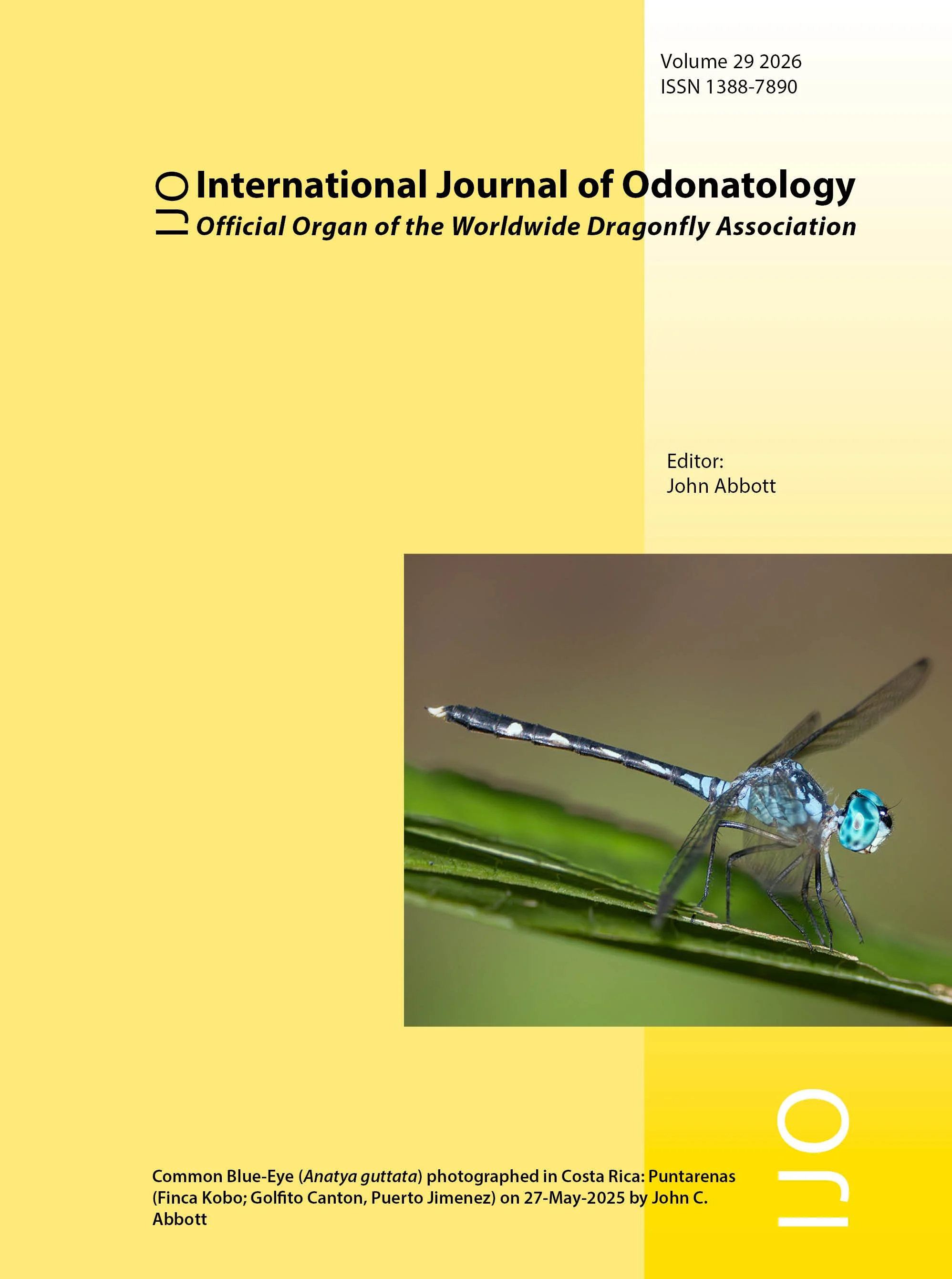
Systematics, divergence time, biogeography, and trait evolution of the dragonfly genus Erythemis Hagen, 1861 (Anisoptera: Odonata)
Systematics, divergence time, biogeography, and trait evolution of the dragonfly genus Erythemis Hagen, 1861 (Anisoptera: Odonata) 00
Katherine O. Montanaa,b ✉️  ,
John C. Abbottc ,
Kendra K. Abbottc,d ,
Lacie G. Newtona,e ,
Rhema Uche-Dikea,b ,
Aaron M. Goodmana,f ,
Seth M. Bybeeg ,
Robert P. Guralnickh ,
Jessica L. Warea
,
John C. Abbottc ,
Kendra K. Abbottc,d ,
Lacie G. Newtona,e ,
Rhema Uche-Dikea,b ,
Aaron M. Goodmana,f ,
Seth M. Bybeeg ,
Robert P. Guralnickh ,
Jessica L. Warea
- Department of Invertebrate Zoology, American Museum of Natural History, 200 Central Park West, New York, NY 10025, USA
- Department of Biology, City University of New York Graduate Center, 365 5th Ave, New York, NY 10016, USA
- The University of Alabama Museums Research and Collections, The University of Alabama, Tuscaloosa, Alabama, USA
- Department of Biological Sciences, The University of Alabama, Tuscaloosa, Alabama, USA
- Department of Biological Sciences, New Jersey Institute of Technology, Newark, NJ 07102, USA
- Department of Entomology, University of Illinois, Urbana-Champaign, 505S Goodwin Ave, Urbana, Illinois 61801, USA
- Department of Biology and Monte L. Bean Museum of Natural History, Brigham Young University, Provo, UT 84602, USA
- Florida Museum of Natural History, University of Florida, Gainesville, FL 32611, USA
International Journal of Odonatology, Volume 29, Pages 125-140, 2026
https://doi.org/10.48156/1388.2026.1917391
Published: 18 June 2026 (Received: 30 April 2026, Accepted: 8 June 2026)
Abstract
The dragonfly genus Erythemis Hagen, 1861, in the hyper-diverse family Libellulidae Leach, 1815, contains ten species that are found across the Americas. Species relationships have never been resolved for this group, and doing so will provide a framework to understand the considerable interspecific variation present in traits, including genital morphology, abdomen shape, and flight activity. Here, we present the most comprehensively sampled phylogenetic reconstruction for Erythemis based on anchored hybrid enrichment (AHE) data. Using an Erythemis fossil as calibration, we estimated the divergence time of the genus to be about 25 million years ago, around the transition between the Oligocene and Miocene. A reconstruction of the ancestral range of the genus revealed a likely origin in central and South America, with subsequent dispersal into the Caribbean. We also performed a likelihood-based ancestral character state reconstruction to test morphological synapomorphies for the group. Interspecific variation in male genitalia morphology stood out, with different penis characters evolving separately. We also found notable variation in abdomen shape and size among species. Our phylogeny provides a basis for understanding evolutionary relationships of all ten Erythemis species, as well as the origins and timing of character innovations, set in their biogeographical context and with respect to the divergence time of the group.
Keywords: Ancestral character state reconstruction, insects, molecular phylogenetics, morphology, taxonomy
Issue section: Original Article
Supplemental Material